
Decorative laminates are commonly bonded to plywood or MDF panels using solvent-based contact adhesives. Chloroprene contact adhesives provide high initial tack and uniform bond strength across large surfaces. Reliable bonding depends on proper surface cleaning, even adhesive application, and allowing sufficient solvent flash-off before pressing the laminate into position.
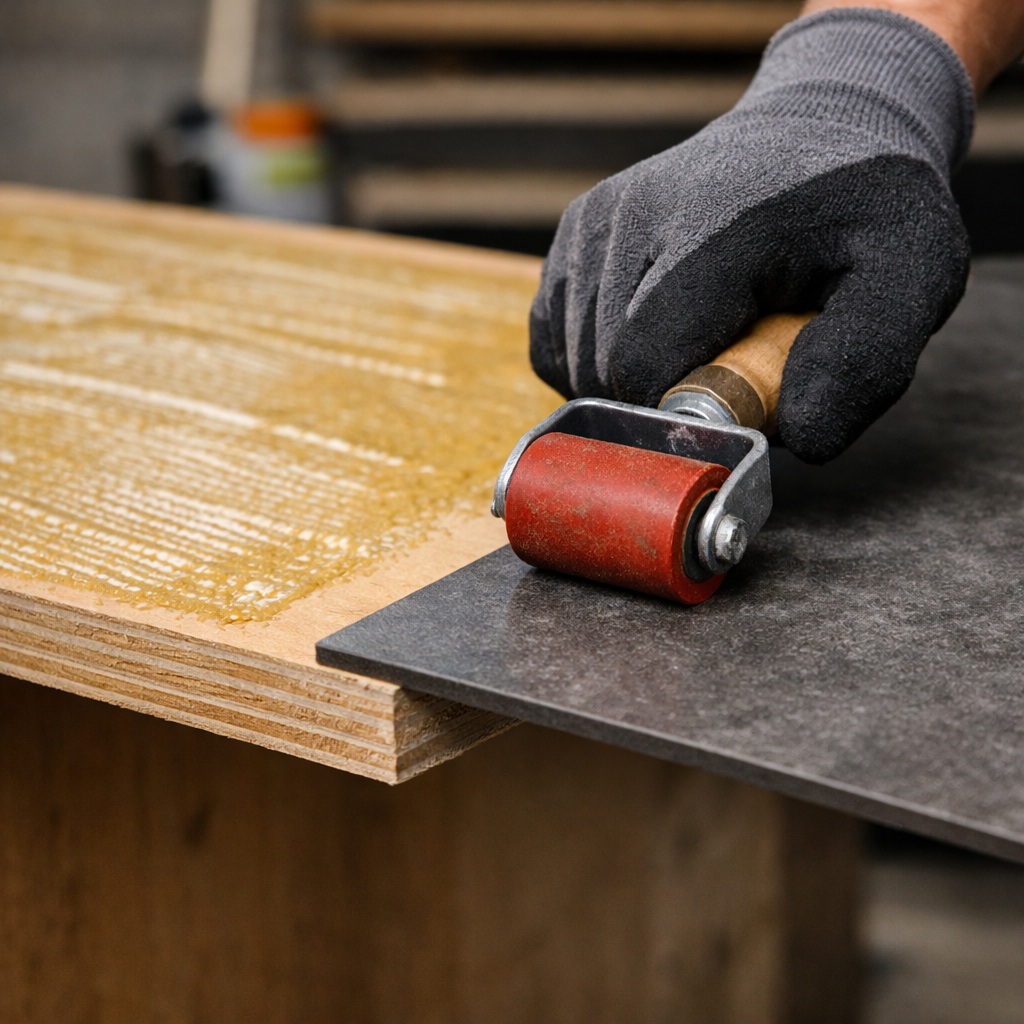
Application Overview
Decorative laminates such as HPL are widely used in furniture panels, cabinets, countertops, and interior wall systems. Bonding laminates to plywood or MDF requires adhesives that provide strong initial tack and uniform bonding across the entire surface area. Contact adhesives based on chloroprene rubber are commonly used because they allow large panels to be bonded quickly without mechanical fasteners.
Surface Preparation
Proper surface preparation improves bond reliability.
Plywood or MDF
- Surface should be dry, smooth, and free from dust
- Remove sanding dust using compressed air or a clean cloth
Laminate (HPL)
- Ensure backside is clean and free from oil or contamination
- Light sanding may improve adhesion for glossy laminate backs
Both surfaces must be completely dry before adhesive application.
Recommended Adhesive Type
Chloroprene Contact Adhesive
Chloroprene-based contact adhesives provide:
- High initial tack
- Good flexibility after curing
- Uniform bonding across large surfaces
- Fast assembly in panel manufacturing and installation
These adhesives are widely used for laminate bonding in furniture manufacturing and interior installations.
Application Method
- Apply adhesive evenly to both laminate and plywood surfaces.
- Allow solvent flash-off until the adhesive becomes tacky but does not transfer to the finger when touched.
- Carefully align laminate sheet with panel surface.
- Press laminate firmly using roller or press to ensure full contact.
- Apply uniform pressure across entire surface to avoid air pockets.
Proper pressure ensures the adhesive forms a consistent bond across the panel.
Common Failure Modes
| Issue | Likely Cause |
|---|---|
| Laminate lifting at edges | Insufficient adhesive coverage |
| Blistering or bubbles | Laminate pressed before solvent flash-off |
| Weak bonding | Dust contamination on panel |
| Uneven bond | Insufficient pressure during pressing |
Substrate Compatibility Considerations
Adhesive performance may vary depending on substrate type, surface condition, and environmental conditions.
Select substrates using the Clyde Bonding Selection Tool to identify compatible adhesive systems for your specific application.
Validate Adhesive Compatibility
Select substrates and application parameters to identify compatible adhesive systems.
Finding Best Match...
No exact product found.
Showing closest recommendation.
Request Technical Recommendation
Thank you. Our technical team will contact you shortly.
Note: Recommendations are for general guidance only
and may not reflect the latest technical updates. Users must conduct
suitability testing before use. Use of this tool constitutes acceptance
of our Terms & Conditions.